Bioreactor and saturated buffer management outreach products
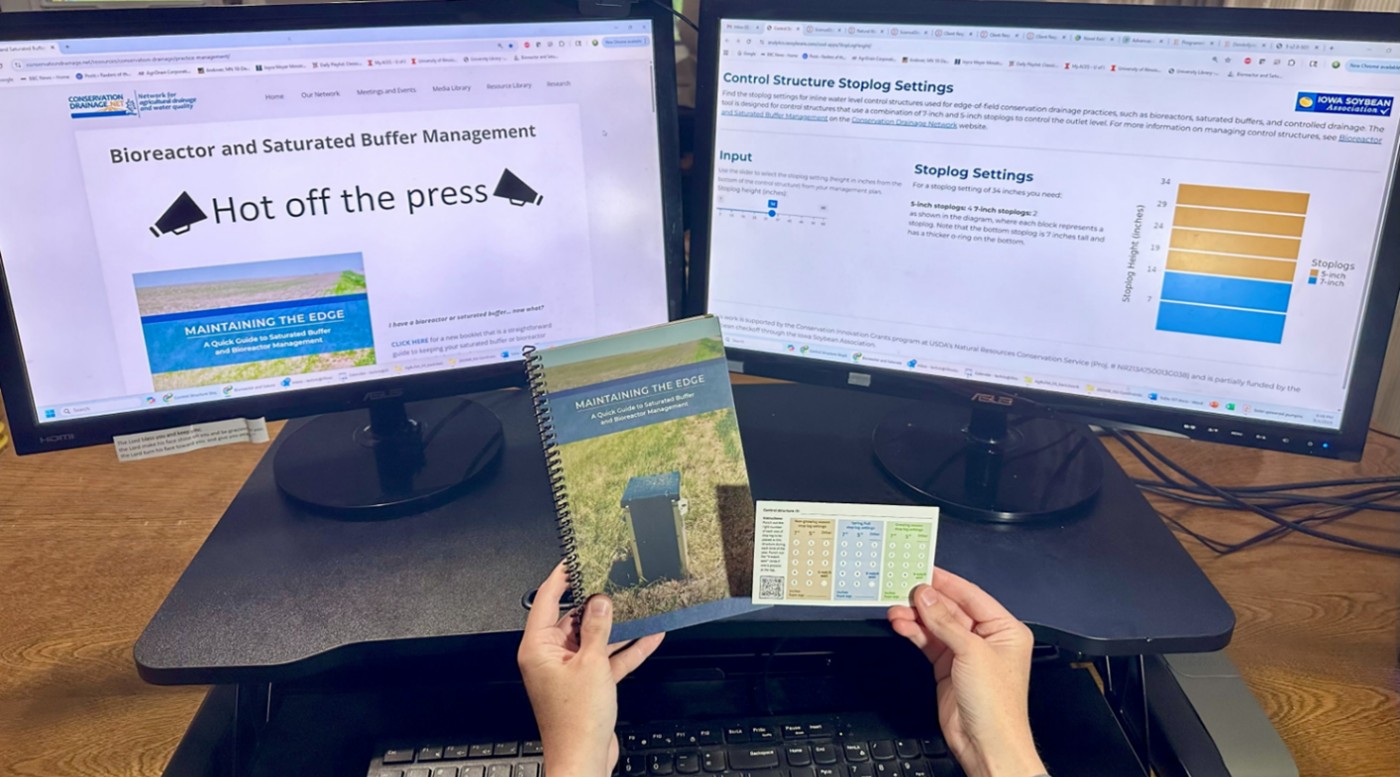 The rapid growth of bioreactors and saturated buffers, especially in Iowa, over the past several years has created a need for more informed outreach in terms of practice management. Although the NRCS provides an “Operation and Maintenance” plan for each practice installation, there are specific nuances of how to actually “do” these plans. As part of a multi-state NRCS Conservation Innovation Grant (NR213A750013G038, see below), we developed a package of bioreactor and saturated buffer management guides and tools.
The overarching materials are detailed online at the Conservation Drainage Network. The table below outlines the products.
| Product | Use and purpose |
| Control structure settings stickers | The sticker is marked to indicate how the stop logs need to be set during different times of the year. The sticker is then attached to the inside of the control structure as a permanent on-site reminder. |
| Online tool: Stop log conversion table
(in inches or in feet-inches) |
NRCS Operation and Maintenance plans often provide control structure stop log settings in terms of the distance from the top of the structure. However, it is sometimes more convenient to know the height of required stop logs as measured from the bottom of the structure. This table converts between the two. |
| Online tool: Stop log slider tool | Stop logs often come in heights of 5 or 7 inches but NRCS Operation and Maintenance plans often give the total height of stop logs needed. This slider tool quickly illustrates the number of required stop logs necessary to achieve a given total height. |
| A 24-page “Maintaining the Edge” management booklet | Describes seasonal and general management of both bioreactors and saturated buffers; Includes a management checklist for both. |
| A six video series:
1. Control structure management 3. Monitoring edge-of-field practices 4. Saturated buffer management |
Videos series that demonstrates management of water control structures as well as management of bioreactors and saturated buffers. These videos supplement the booklet in the row above. |
Outreach materials lead: Chris Hay (Hay Water Solutions)
Innovating through barriers for bioreactors and saturated buffers
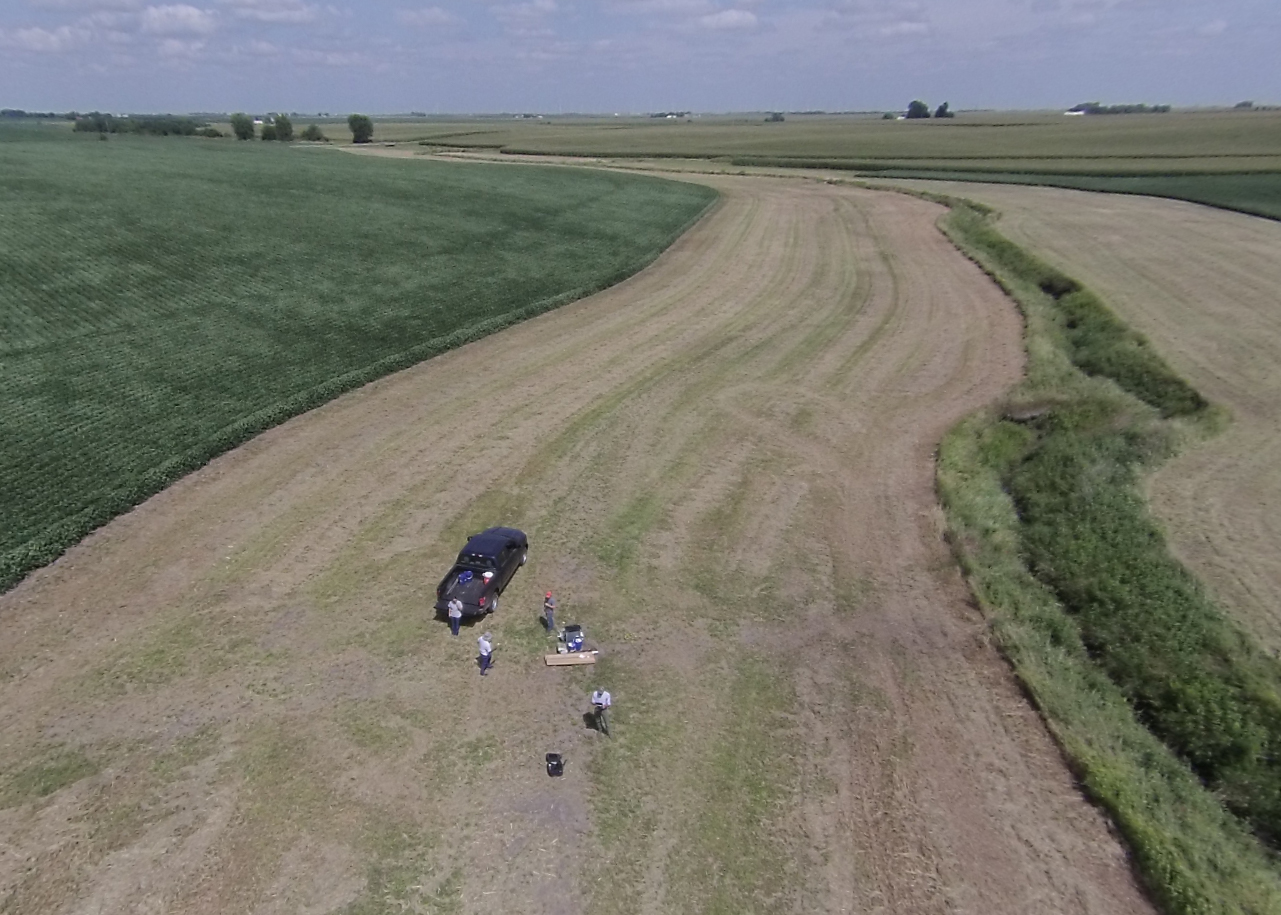 The overarching goals of this multi-state USDA NRCS Conservation Innovation Grant project are to apply innovative design, assessment, and monitoring techniques to clean more N from tile drainage water leading to accelerated denitrifying woodchip bioreactor and saturated buffer adoption across the US Midwest. Three proposed objectives will allow: bioreactors and saturated buffers to treat more water, more effectively in field demonstrations; systematic analysis of existing adoption-scaling limitations for these two practices across Iowa, Illinois, and Minnesota; and evaluation of novel monitoring methods that could lead to market-based water quality solutions.
Funding Partner: USDA Natural Resources Conservation Service
Co-PIs: R. Christianson, R. Cooke, M. Helmers, M. Soupir, T. Isenhart, C. Hay, L. Abendroth, G. Chighladze, L. Pease, G. Feyereisen, and J. Kjaersgaard (L. Christianson, Lead PI)
** Access a 2-page saturated buffer factsheet here. **
Drainage water management and saturated buffers for achieving Illinois Nutrient Loss Reduction Strategy goals
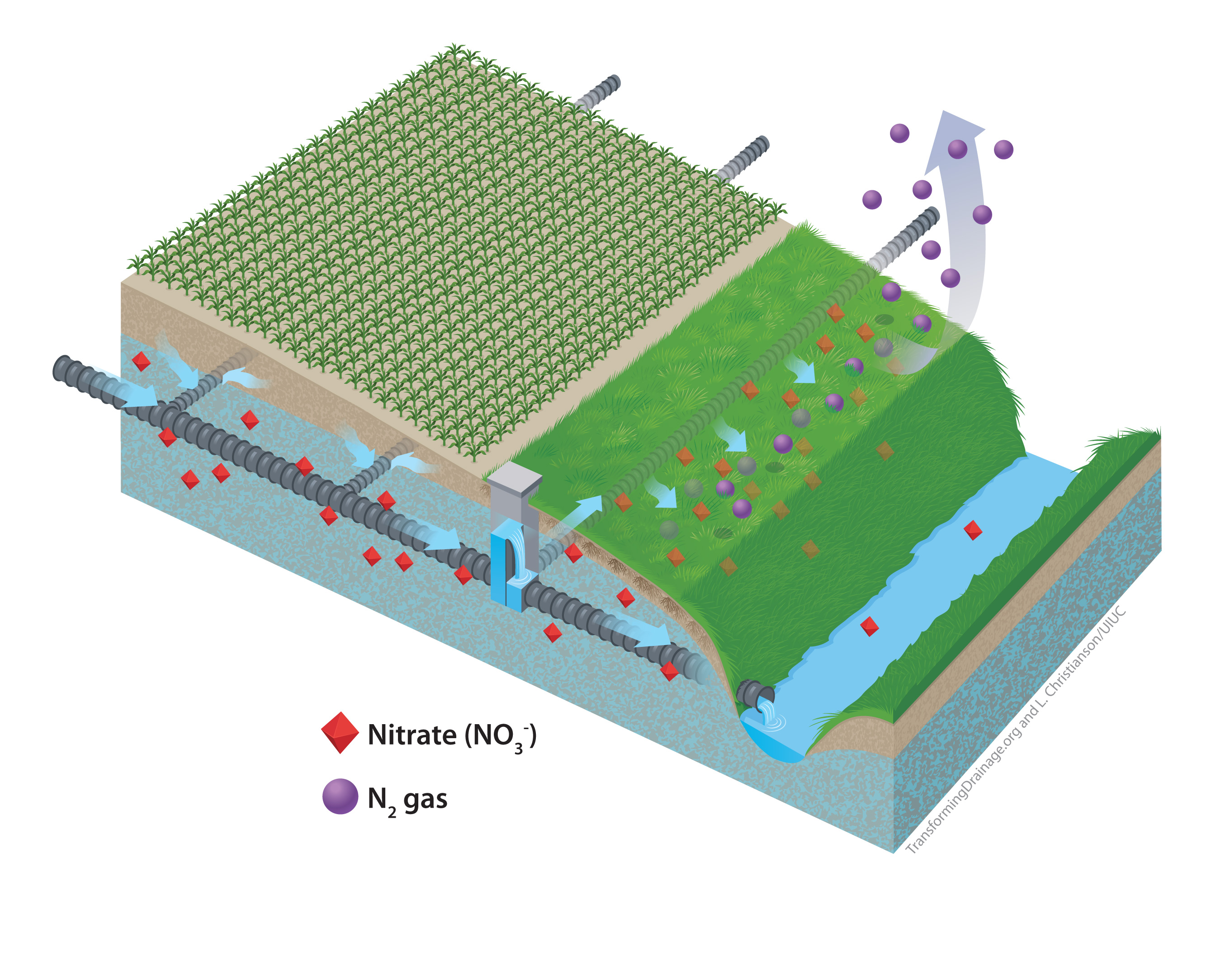
Agricultural producers farming the 9.7 million acres of tile-drained land in Illinois need a wide variety of proven options to reduce nitrogen loss. Two practices that may reduce tile drainage N loss, but are not in the Illinois Nutrient Loss Reduction Strategy, are drainage water management (or, controlled drainage) and saturated buffers. The goal of this work is to evaluate N loss reduction provided by these two practices to assess their potential inclusion as recommended practices in Illinois.
Funding Partner: Illinois Nutrient Research and Education Council
Co-PIs: Drs. Richard Cooke and Paul Davidson, Biological & Agricultural Engineering, University of Illinois (L. Christianson, Lead PI)
Balancing water quality and nutrient management goals for the sustainable intensification of corn systems (continuation: 2021-2023)
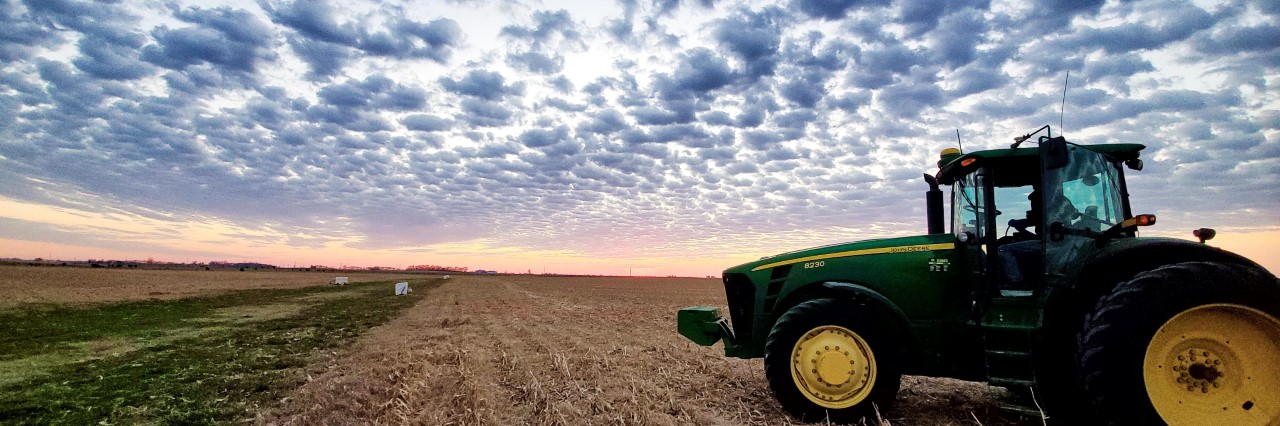 The Illinois Nutrient Loss Reduction Strategy provides guidance on suggested conservation practices to improve agricultural water quality, but there is limited scientific evidence on the effectiveness of these practices when implemented in combination in Illinois corn production systems. We have established a sustainable intensification research site at the University of Illinois Dudley Smith Farm with the aim of evaluating the combined effects of water quality practices on tile drainage nutrient losses, nutrient use efficiencies, and crop yields.